
Out There
The sky keeps better records than we do, and most of them are still being read.
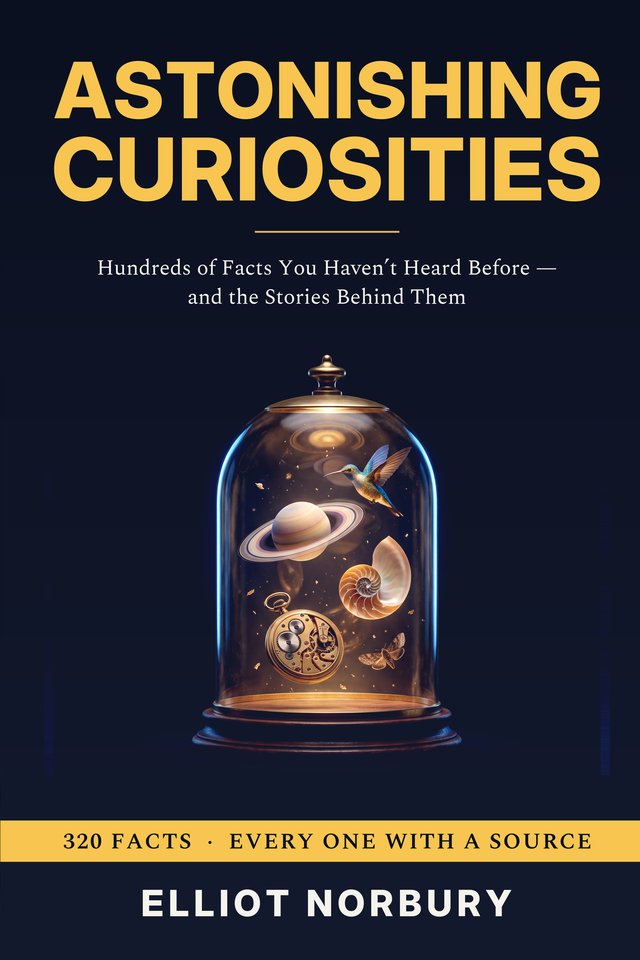
320 facts you haven't heard before, and the stories behind them. Corals that counted the days. A star that switched on a world's fair. A letter that quietly left the alphabet. Open it anywhere — nothing here builds on anything before it.
Paperback · 6×9in · 256 pages · 320 entries · publishing soon
The problem
Trivia collections copy each other. A story gets repeated until it sounds true, nobody checks where it started, and half the shelf ends up carrying the same handful of myths.
This book was built the other way round: nothing goes in that cannot be traced to a named work. Several famous stories did not survive that rule, and the entry says so instead of repeating them.
What's inside
Each entry is a fact, then the story or the mechanism behind it, and every one is tied to the work it came from. Around a hundred words — long enough to be worth knowing, short enough to read standing up.
The sky keeps better records than we do, and most of them are still being read.
The strangest machine you will ever operate, and nobody handed you the manual.
The things you handle every day were shaped by accidents, shortages and arguments.
Words carry their history quietly, and much of what everyone knows about it is wrong.
The other species here are stranger than their reputations, and most have never had one.
Dinner is the end of a long argument between chemistry, weather, shipping and rules.
Every number in your life was agreed on by somebody, and a surprising share were wrong.
Almost nothing was invented the way the plaque says, and the detours are better.
Borders and place names are decisions somebody made, stranger than the results look.
Every rule eventually meets a situation its author never imagined. The rule usually wins.
Why the full list lives here
A list of 320 citations is about twenty-five pages of a book nobody reads in a bookshop and everybody wants to check later. So the book prints the principal works at the back, and the full list lives here, where it can be searched, followed and corrected — and where it costs no paper.
The list is complete and in the same order as the entries in the book. Sources are given as the names of works rather than as web addresses: links rot within a few years, and a named book, paper or archive can still be found in twenty.
Free download
Twenty things from this book worth saying out loud, and what to say when somebody asks whether you're making it up — a printable PDF, every fact traced to its source. Plus a note whenever a new book hatches.
One email to confirm, then the pack. No spam, unsubscribe in one click — see the privacy notice.
Check your inbox and click the confirmation link — the pack lands right after. Nothing within a few minutes? Look in spam, then write to hello@hoothatch.com.
About the author
Elliot Norbury collects obscure facts, and more particularly the stories sitting behind them — who worked the thing out, what they believed first, and how anyone came to be certain. He is less interested in whether a fact is surprising than in whether it holds up, and he goes to the original paper or the archive record when one exists. He would rather cut a good story than print one he cannot stand behind, and he has cut a great many.
Questions
No — that's the point. Nothing builds on anything before it, so there is no page you have to reach first and no thread to lose. Read three entries and put it down, or read forty and miss your stop.
On this site, in the order the entries appear in the book. Every one of the 320 entries has a named work behind it — a book with a publisher and a year, a paper with a journal, an archive, a museum, or a published standards document. The principal works are also listed at the back of the book.
Two ways. Each entry gives the story or the mechanism behind the fact, not just the fact. And where a famous story turned out to be wrong or disputed, the book says so and says who disagrees, rather than passing on the tidier version.
It was built for it: something to leave on a table, open at random, and read out loud to whoever is in the room. Sixty of the entries come with a boxed question meant to be asked out loud.
The paperback comes first. Sign up above and you'll hear when anything else appears.